
In January 2026, Team4Tech concluded a 10-week skills-based volunteering project in collaboration with the Autodesk Foundation and Kheyti. Team4Tech connected 10 Autodesk employee volunteers and Kheyti’s technical team to co-design sustainable solutions for strengthening data systems and automating pest and crop diagnosis for smallholder farmers.
The project focused on two core areas:
- Improving Kheyti’s data architecture to enable sustainable growth, and
- Developing an automated, AI-powered system to increase the efficiency of Kheyti’s farmer advisory service

Supporting Smallholder Farmers Across India
There are nearly 126 million smallholder farmers in India, who are increasingly vulnerable to climate change and environmental degradation. Many face challenges that threaten their income, including pesticide pollution, declining crop yields, water scarcity, and destructive rainfall. Kheyti, an NGO based in Hyderabad, India, and an Autodesk Foundation portfolio organization, is addressing this growing crisis.
Kheyti developed the “Greenhouse-in-a-Box,” a low-cost modular greenhouse designed for small plots of land. The solution enables farmers to grow crops year-round while significantly reducing water use and agricultural inputs. Kheyti pairs the greenhouse product with comprehensive support services, including:
- crop education and training,
- access to seeds and inputs, and
- tech-enabled advisory via WhatsApp communication.
These services help farmers boost their income while adopting more climate-resilient farming practices.
To date, more than 7,000 farmers across India have benefited from Kheyti’s approach. This project comes at a pivotal time as Kheyti prepares to scale their work to one million farmers by 2033.
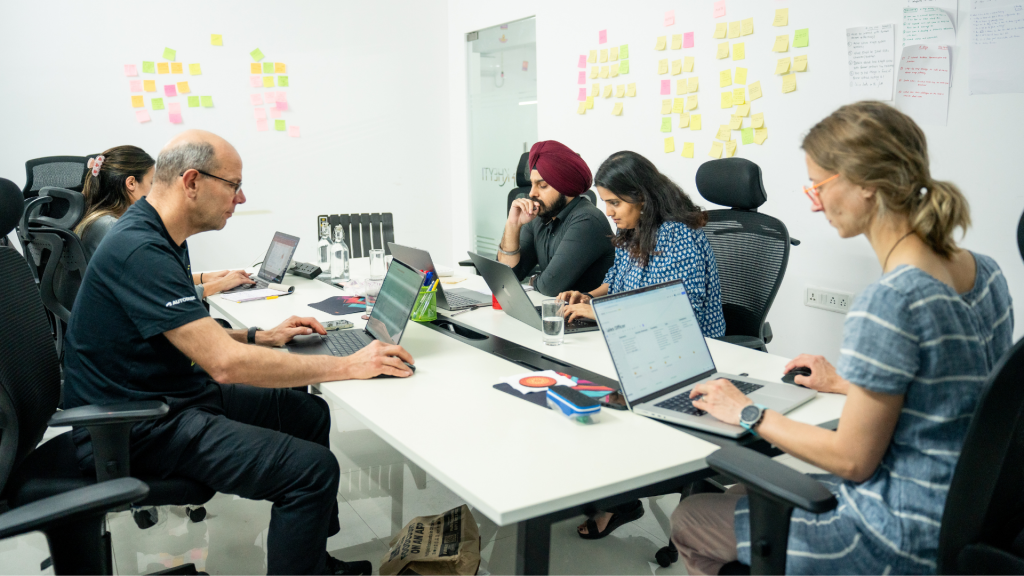
A Diverse Group of Employee Volunteers Creates Positive Change
Team4Tech and the Autodesk Foundation brought together ten skilled employee volunteers from India, Israel, the U.K., and the U.S. to co-design tools and strategic recommendations to support Kheyti’s goals for scale.
Team4Tech staff guided volunteers through a leadership development curriculum to build skills in human-centered design, cross-cultural collaboration, and decision-making.
Over three months of collaboration, the team:
- Conducted discovery sessions to better understand Kheyti’s workflows and operational challenges;
- Prototyped and tested tools with Kheyti’s technical team and field staff;
- Traveled to Hyderabad, India, for two weeks of in-person collaboration, discovery, and learning;
- Implemented human-centered design grounded in the lived experience of farmers and staff; and
- Synthesized and prioritized insights into actionable recommendations.
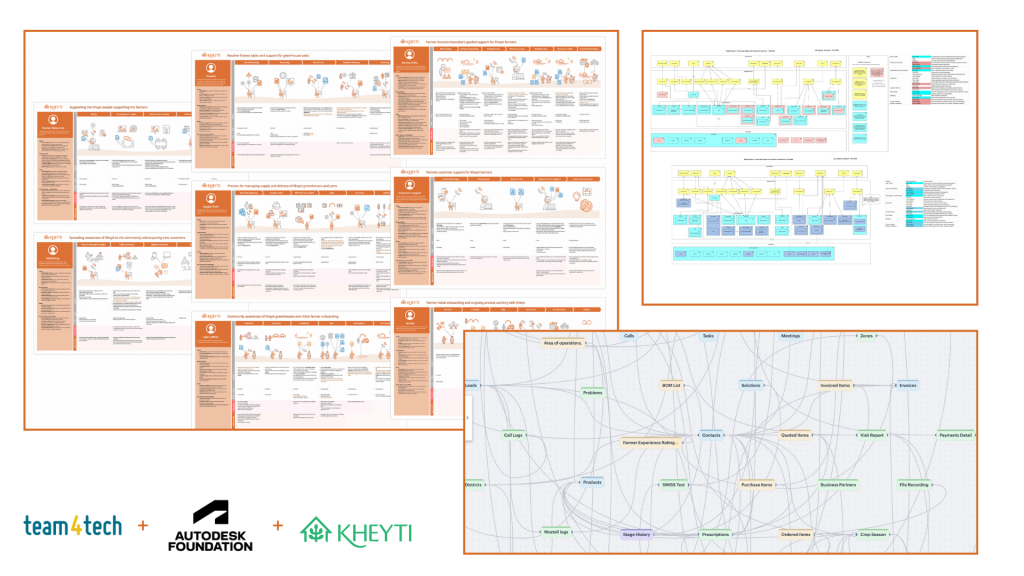
Improving Kheyti’s Data Architecture
Before the project, Kheyti’s farmer and operational data was fragmented across multiple systems, including the customer relationship management (CRM) tool Zoho, third-party applications, and spreadsheets. This fragmentation created challenges like duplication, inconsistent field definitions, and delayed insights, posing an increasing operational risk as Kheyti grows.
One subteam of volunteers tackled these data architecture issues, working closely with Kheyti to audit existing systems, identify pain points, and redesign the data model to align with user journeys. The team also recommended governance practices to support clean, reliable data over time. This work resulted in a unified, user-centric data architecture and mapped workflows to serve as a single source of truth for the organization.
Key Deliverables:
- User Journeys: End-to-end user journey maps across key roles, providing clear visibility into pain points, handoffs, and manual workarounds.
- Business Architecture: Documentation of current workflows, scalability risks, and recommendations for ongoing data governance.
- Data Model: Assessment of the existing CRM with recommendations to improve data quality and reporting for a scalable future state.
Recommendations and Roadmap: Detailed guidance across operations, governance, and systems that includes templates, examples, and a phased 24-month technology roadmap.

Automating Farmer Advisory Services
Kheyti had faced communication challenges between their advisory staff and farmers. Farmer Success Associates (FSAs) worked against time-intensive diagnoses, agronomist scheduling, and systems limitations—constraints that made it increasingly difficult for Kheyti to scale its advisory services.
The other subteam of employee volunteers leveraged AI to streamline these processes. They worked closely with Kheyti to evaluate two technical approaches for image recognition, developed cost estimates for scaling, and designed an automated workflow for WhatsApp conversations to reduce manual effort for farmers and FSAs.
Key Deliverables:
- Workflows and Data: Tested multiple large language models (LLMs) using filtered Zoho data to classify pests and diseases, with confidence scoring to support decision-making.
- Evaluation Metrics: Compared pre-trained and custom-trained models using sample datasets, with clear explanations of evaluation methods and tradeoffs.
- Cost Analysis: Assessed infrastructure and scalability tradeoffs across models, providing cost estimations to guide Kheyti’s early decision-making.
- Conversational Flow: Designed an automated ticket-creation flow driven by farmer-FSA WhatsApp conversations to reduce manual effort.
- 9-Image Protocol: Redesigned the image protocol for plant diagnosis and optimized usability for mobile and WhatsApp submission.
The volunteers grounded their solutions in a farmer-centered approach, ensuring recommendations aligned with real-world use in the field. Together, these deliverables will support Kheyti to predict, detect, and advise farmers proactively, improving response time, diagnostic accuracy, and overall crop outcomes.
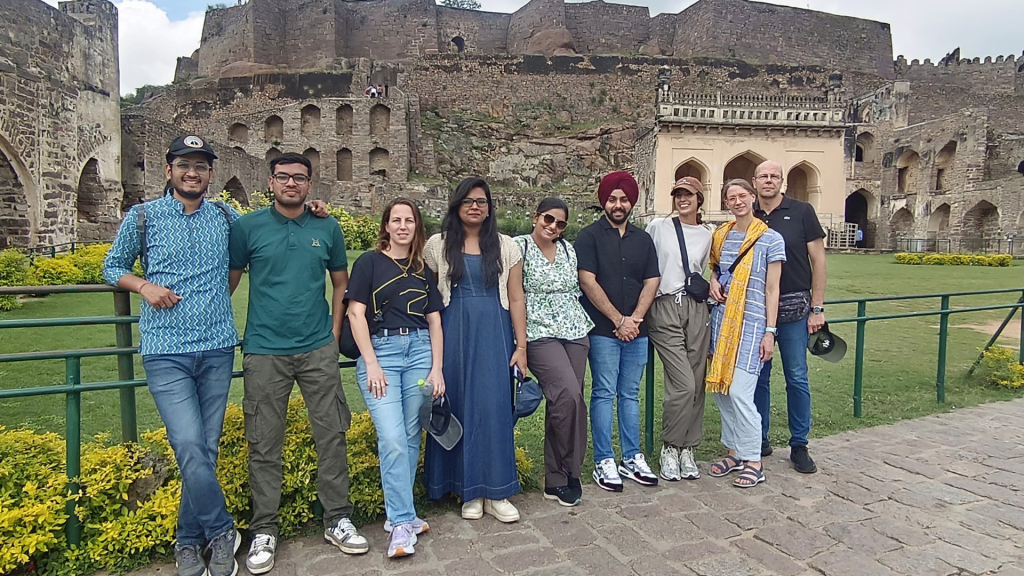
Collaboration and Cultural Exchange in Hyderabad
Midway through the project, Team4Tech facilitated an on-site, two-week immersion in Hyderabad, where employee volunteers and Kheyti staff worked side by side to conduct user interviews, field visits, test early concepts, and make recommendations for implementation. After returning home from India, the team continued collaborating virtually to incorporate on-the-ground learnings and refine their solutions.
Beyond the technical outcomes of this project, employee volunteers shared cultural experiences, deepened relationships, and strengthened their leadership and collaboration skills. The immersion highlighted the importance of human relationships and how technology can meaningfully support and enhance the connection between farmers and Kheyti.
Some projects sharpen your skills, but the pro-bono immersion reminded me why those skills matter. One day, I was in the fields, sitting with farmers, hearing their stories. The next, I was turning those conversations into solutions. That duality changed how I see my work. Users stopped being data points. Problems stopped being tickets. Every technical decision carried the weight of a real person’s livelihood.
I’ll carry this forward, the reminder that technology means nothing until it truly understands the people it serves.”
— Rajat Gupta, Software Development Engineer, Autodesk
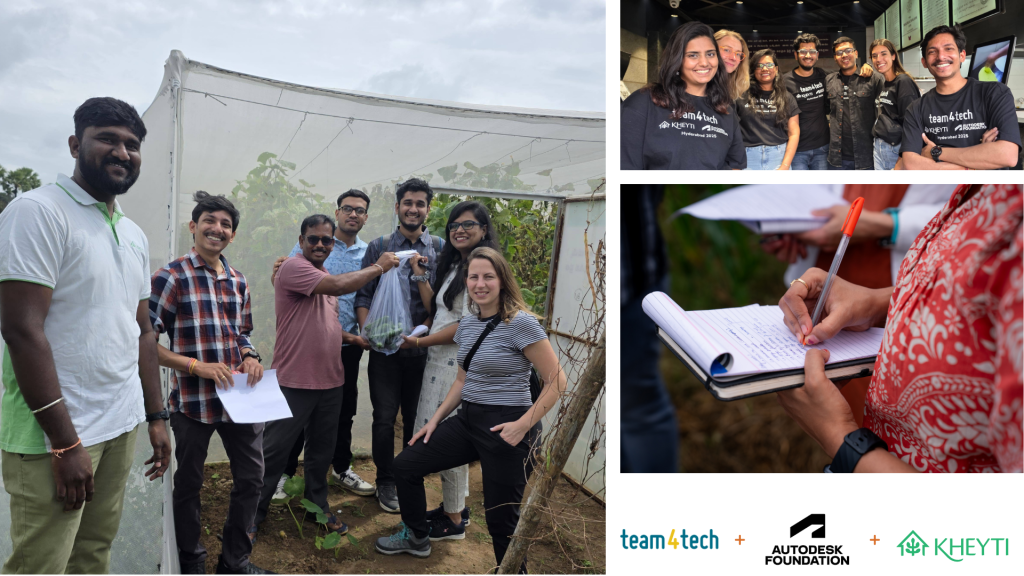
Employee Volunteers Created Positive Change and Prepared the NGO to Scale
The project delivered meaningful, human-centered results. Kheyti is now equipped with clear insights and recommendations to strengthen its data architecture, streamline user workflows, and thoughtfully introduce automation. The team’s deliverables provide a strong foundation for scalability, supporting Kheyti to reach more smallholder farmers across India.
Working alongside Autodesk colleagues to create real-world impact was incredibly rewarding. Team4Tech’s unique value is the opportunity to engage with partners in person and apply human-centered methodologies end to end, allowing participants to experience the full design process—from discovery and immersion through synthesis and delivery.”
— Amanda Cilek, Principal User Experience Designer, Autodesk
This project marks Team4Tech’s tenth skills-based volunteering program with Autodesk employees since 2015. Skills-based volunteering is just one element of Team4Tech’s accelerator model, building capacity for community-based organizations worldwide. Learn more about how Team4Tech supports NGOs around the world.