Team4Tech’s recent “The Civic Code: AI for Good” event in New York City brought together nonprofit leaders, corporate changemakers, and technologists to explore how artificial intelligence can be harnessed for social good.
The day was split into two dynamic parts:
- A speaker series featuring four visionary leaders offering distinct but deeply connected perspectives on how artificial intelligence can serve the social sector
A hands-on Design for Impact Workshop where attendees collaborated to address real-world nonprofit AI challenges
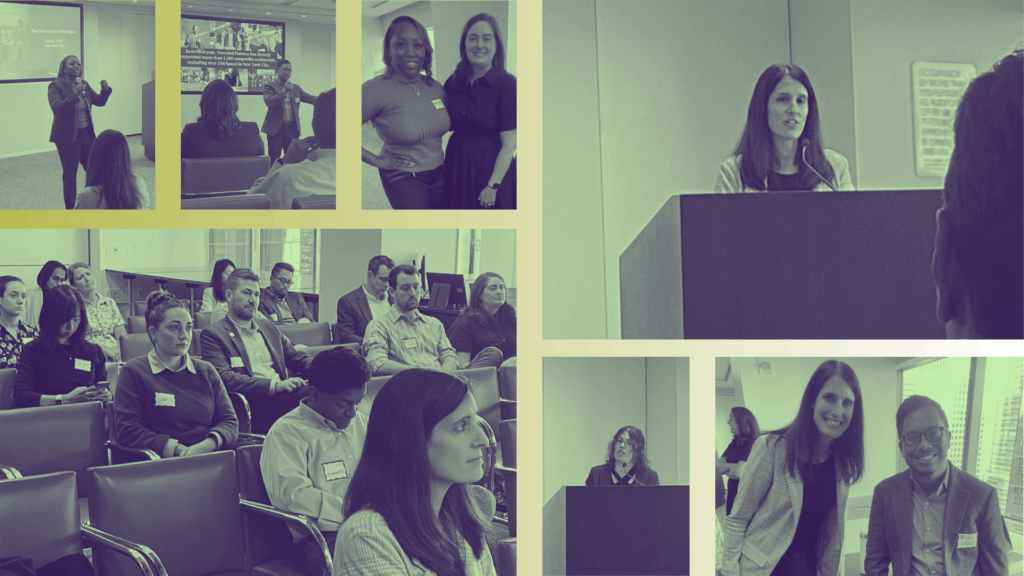
An All-Star Lineup of Impact Leaders
Amanda Misbe from Adobe opened with a compelling look at how creativity and community intersect through AI. She highlighted Firefly, Adobe’s generative AI tool, as a catalyst for storytelling and capacity-building—from a creative residency with MoMA to curriculum guides for educators. Her emphasis on employee-led programs like the Pro Bono Residency and Vets in Tech showed how corporate volunteers can meaningfully support nonprofits through skills-based volunteering to bridge skill gaps using tools like Adobe Express.
Patrice Key built on this theme of intentionality, urging nonprofits to resist the temptation to jump into AI without a clear strategy. “AI is teaching me to ask better questions,” she said, underscoring that clarity—about mission, values, and the problems being solved—is the true foundation for effective tech adoption. Her remarks echoed Amanda’s: both emphasized that tools are only as powerful as the purpose behind them.
Bryan Lozano of Tech: NYC Foundation took that idea further, sharing how his initiative helps nonprofits move from uncertainty to action. By categorizing AI use cases into buckets like “Answer & Assist” and “Automate the Admin,” Bryan offered a framework that complements Patrice’s call for simplicity and structure. His work with over 1,100 nonprofits, including HeartShare and the Bronx Museum, showed that hands-on experimentation is key to adoption—and that the social sector has a unique responsibility to shape AI ethically.
Emily Friedman closed the speaker series with a global lens, sharing research on youth workforce readiness and attitudes toward AI. Her findings revealed a disconnect between how prepared young people feel and how employers perceive them—a misalignment that mirrors gaps Patrice and Bryan also described. Emily’s upcoming AI framework for youth-serving nonprofits will help bridge that divide, bringing industry partners into the conversation and expanding support beyond the U.S.
Together, these speakers painted a picture of AI not as a silver bullet, but as a tool that requires clarity, collaboration, and care.

A Fast-Paced Design Thinking Process Brings Abstract Concepts to Life
The second half of the event invited attendees into the action. In a facilitated skills-based volunteering Design for Impact Workshop, attendees applied their skills to a nonprofit AI challenge. Team4Tech guided participants through design thinking exercises, where they co-created solutions that were not only imaginative but also grounded in the needs of the communities they aim to serve.
“The Civic Code: AI for Good” wasn’t just a conversation—it was a call to action. From creative residencies and pro bono programs to ecosystem-level insights and strategic frameworks, the event underscored that AI is only as powerful as the purpose behind it. As Amanda, Patrice, Bryan, and Emily each reminded us in their own way: the future of AI in the social sector depends on clarity, collaboration, and courage.
If you’re interested in joining the movement—whether as a volunteer, partner, or learner—Team4Tech is building the bridge between innovation and impact. Let’s cross it together.